
Floyd County Arrest Records and Charges
Floyd County arrest records come from the law-enforcement side of an event. They may involve the arresting agency, booking route, jail custody, bond, incident or crash report, or local police records. Those records are different from the court charge record. A court charge begins when the prosecutor or court process files a formal allegation in a criminal, citation, or infraction case. The charge record can show offense, statute, level or class, filed date, court, bond connection, and current status.
Sheriff Steve Bush's Floyd County Sheriff's Department handles jail and sheriff records at 175 W. Spring Street, while Floyd County Prosecutor Chris Lane decides many formal charges after police investigation or arrest. The New Albany Police Department also keeps local incident and crash-report records for city matters. Once a case is filed, court charge details are tracked in MyCase and clerk records in the New Albany-Floyd County City-County Building. The full criminal court case, including pleas, motions, disposition, and sentence, belongs in the criminal court record rather than the arrest record alone.
The New Albany Police Department records information is one local source for police reports tied to Floyd County arrest records.
Police records may explain an arrest event, while court records show the charges filed afterward.
Find Floyd County Arrest Records
For court charges after arrest, search Indiana MyCase by defendant name, case number, citation number, or cross-reference number. Narrow by Floyd County court, criminal/citation category, status, and filing date. For custody or bond after arrest, use the Floyd County Jail AIS at 812-948-5406, the MobilePatrol app if available for the agency, or the Indiana County Jail Public Portal. For police reports, contact the sheriff, New Albany Police, or the agency that made the report.
- Identify whether the question is about booking, police report, court charge, or final case outcome.
- Use jail or police channels for arrest, custody, bond, crash, or incident-report records.
- Use MyCase for the court charge list, charge status, hearings, and case events.
- Contact the Floyd County Clerk for certified court copies or public documents not linked online.
- Read disposition and sentence fields before treating any charge as a conviction.
New Albany Police reports are generally available three business days after police submission. Incident reports and limited local background checks have no charge, while vehicle crash reports cost $8 in person or $12 online. Sheriff crash reports have the same $8 in-person and $12 online costs. Those law-enforcement report routes are separate from court charge records and clerk-certified court documents.
Charges After Arrest in Floyd County
After an arrest, the prosecutor reviews the law-enforcement material and decides what formal charges, if any, to file. The Floyd County Prosecutor's Criminal Division handles felony, misdemeanor, juvenile, traffic, infraction, victim, investigator, and VINE-related work. The charge record is then filed with the court and appears as part of the criminal or citation case. One arrest can produce no filed charge, one charge, or several charges.
Newly arrested people may appear in court the following business day according to the Floyd County Sheriff's FAQ, and morning court assignments are handled by the clerk and courthouse postings. The court record may show an initial hearing, counsel, bond, and future settings. Later docket entries can show whether a charge was amended, reduced, dismissed, or resolved by plea or trial.
| Complaint | Information | Indictment | |
|---|---|---|---|
| Filed By | Officer or prosecutor process | Prosecutor | Grand jury process |
| Common Use | Initial accusation or lower-level filing | Common formal charging document | More formal charge route in serious matters |
| Record Effect | Starts or supports the court charge | Opens or defines the criminal case | Creates formal charges after grand jury action |
| Where It Appears | Court docket or clerk-held file | Court docket or clerk-held file | Court docket or clerk-held file |
Floyd County Charge Status
Charge status is the key field for court charges after arrest. A pending charge is unresolved. An amended or reduced charge means the filed allegation changed. A dismissed charge is no longer being pursued in that case. A conviction requires a guilty plea, guilty verdict, or other guilty finding. The same criminal case can show different outcomes for different counts.
| Status | What It Means |
|---|---|
| Pending | The charge remains active and has not reached final disposition. |
| Amended | The prosecutor or court record changed the original charge wording, statute, or count. |
| Reduced | The charge moved to a lower offense or severity level. |
| Dismissed | The charge was ended without a conviction on that count. |
| Guilty / Convicted | The record reflects a guilty plea, verdict, or finding for that count. |
| Expunged / Sealed | Public access may be restricted after court action or by rule. |
Note: Always match the disposition to each charge count before calling a Floyd County charge a conviction.
Floyd Charges vs Convictions
A Floyd County charge is a formal accusation. A conviction is the legal result after a plea, verdict, or finding. Arrest records, charge records, and conviction records answer different questions. An arrest record can show that law enforcement took a person into custody. A charge record shows what was filed in court. A conviction shows that one or more charges ended in a guilty result.
| Charge | Conviction | |
|---|---|---|
| Stage | Filed after arrest, citation, or investigation | Entered after plea, verdict, or finding |
| Proof | Allegation based on charging decision | Legal guilt on a specific count |
| Where to Read | Charge list, filing entry, and docket events | Disposition, judgment, and sentencing entries |
| Can Be Public | Often public unless restricted | Often public unless sealed or expunged |
Charge Codes and Severity Levels
Floyd County court charge records may include Indiana statutes, offense names, case-type codes, severity levels, and court identifiers. Criminal case-type examples in the research include CM for criminal misdemeanor, CF for older criminal felony, XP for expungement, and criminal/citation categories in MyCase. The court identifier helps show where the charge is pending, such as 22C01, 22D01, 22D02, or 22D03.
Severity matters, but it does not tell the whole story. A felony is a more serious criminal offense category. A misdemeanor is lower-level criminal conduct. An infraction is usually noncriminal and often handled through fines. Traffic citations can still create court charge records, especially when a court appearance is required. Floyd County traffic infractions and ordinance violations generally route to Superior Court 2 unless local rules send a military-history matter to Superior Court 3.
- Charge
- The filed criminal or infraction allegation.
- Statute
- The law alleged to have been violated.
- Disposition
- The result or current outcome of a charge.
- Bond
- Security for release while the case is pending.
Public Access to Floyd Charge Records
Indiana court access starts with Access to Court Records Rule 4, which makes court records public unless a law, rule, or court order says otherwise. Rule 5 lists excluded and redacted material. Rule 6 explains how a person can ask to exclude an otherwise public record. Rule 9 explains how someone may ask to access an excluded record. Administrative Rule 9 controls remote access and bulk court data.
These rules matter because arrest records and court charges can involve sensitive details. Public MyCase may show a charge but hide protected identifiers. Law-enforcement reports may be handled under Indiana public-record law, while court charges are controlled by court-record rules. The clerk is the copy source for public court records, and the sheriff or police department is the source for incident, crash, jail, and booking records.
Rule 4 is the general public-access rule for Floyd County court charge records.
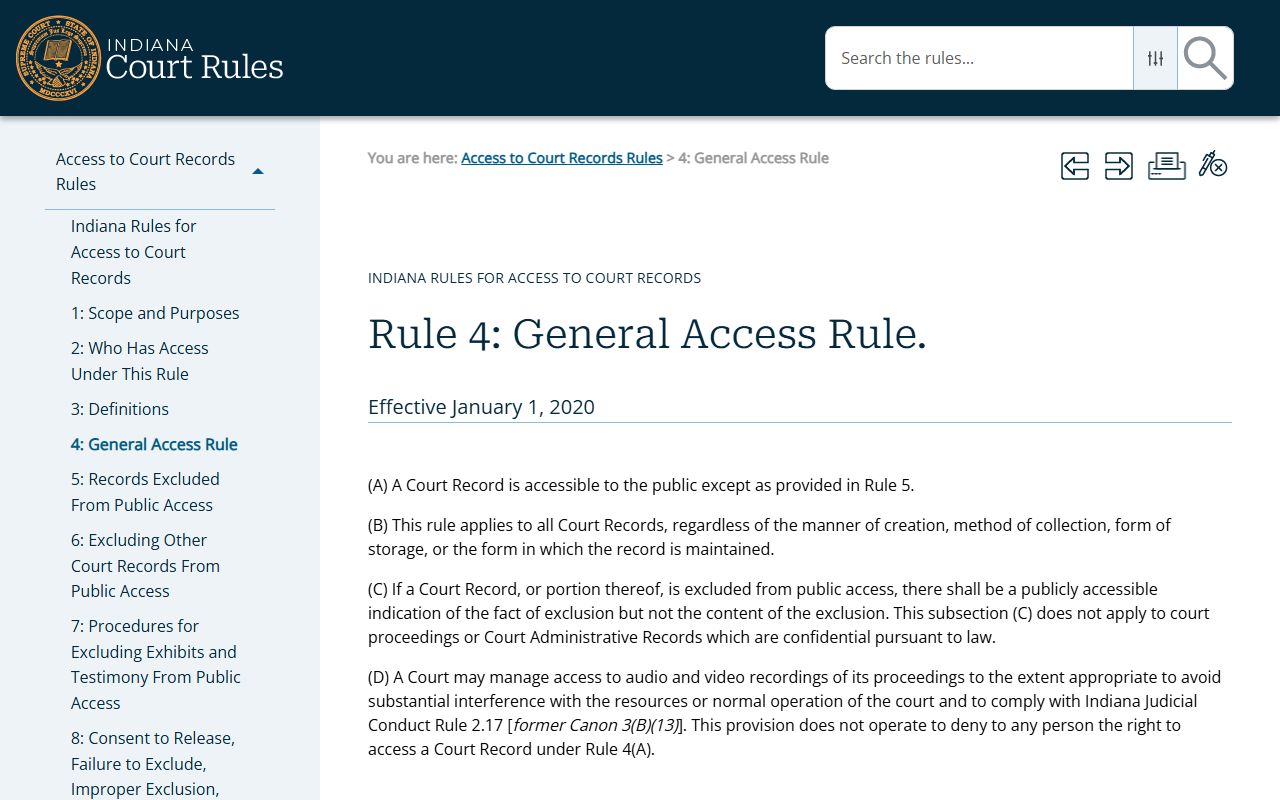
That rule is the starting point before exclusions and redactions are applied.
Rule 5 lists the court records and data excluded from public access.
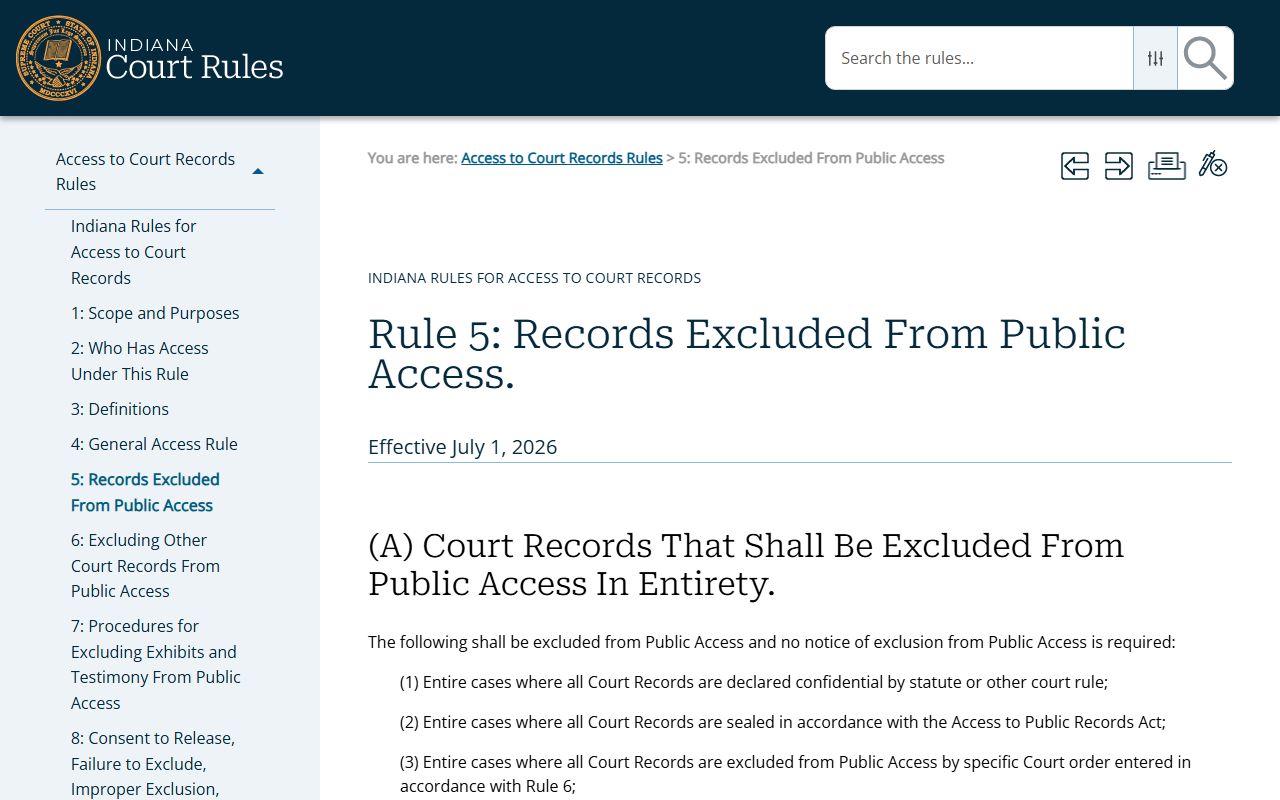
Rule 5 is why some arrest-related court details do not appear in public search results.
Rule 6 covers requests to exclude otherwise public court records.
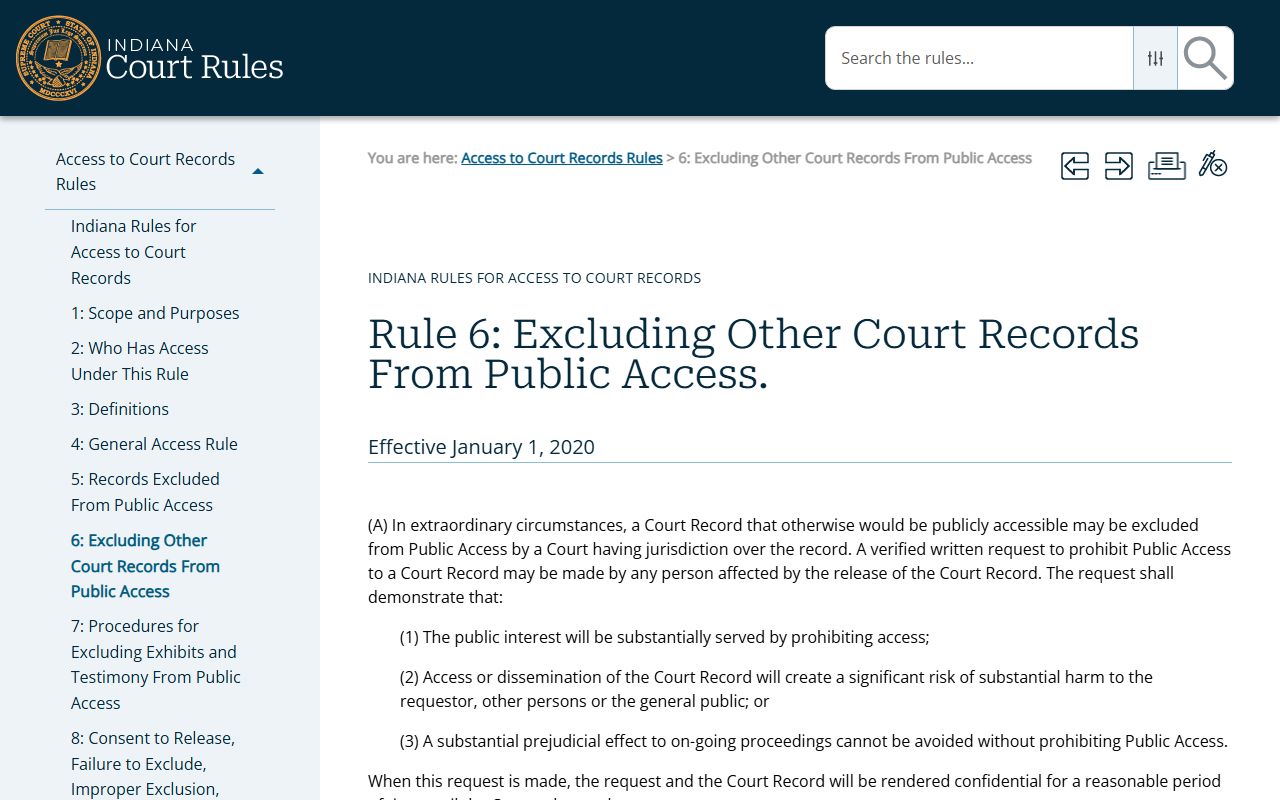
That process is relevant when a party seeks restriction of a public charge-related record.
Rule 9 addresses requests to access excluded records.
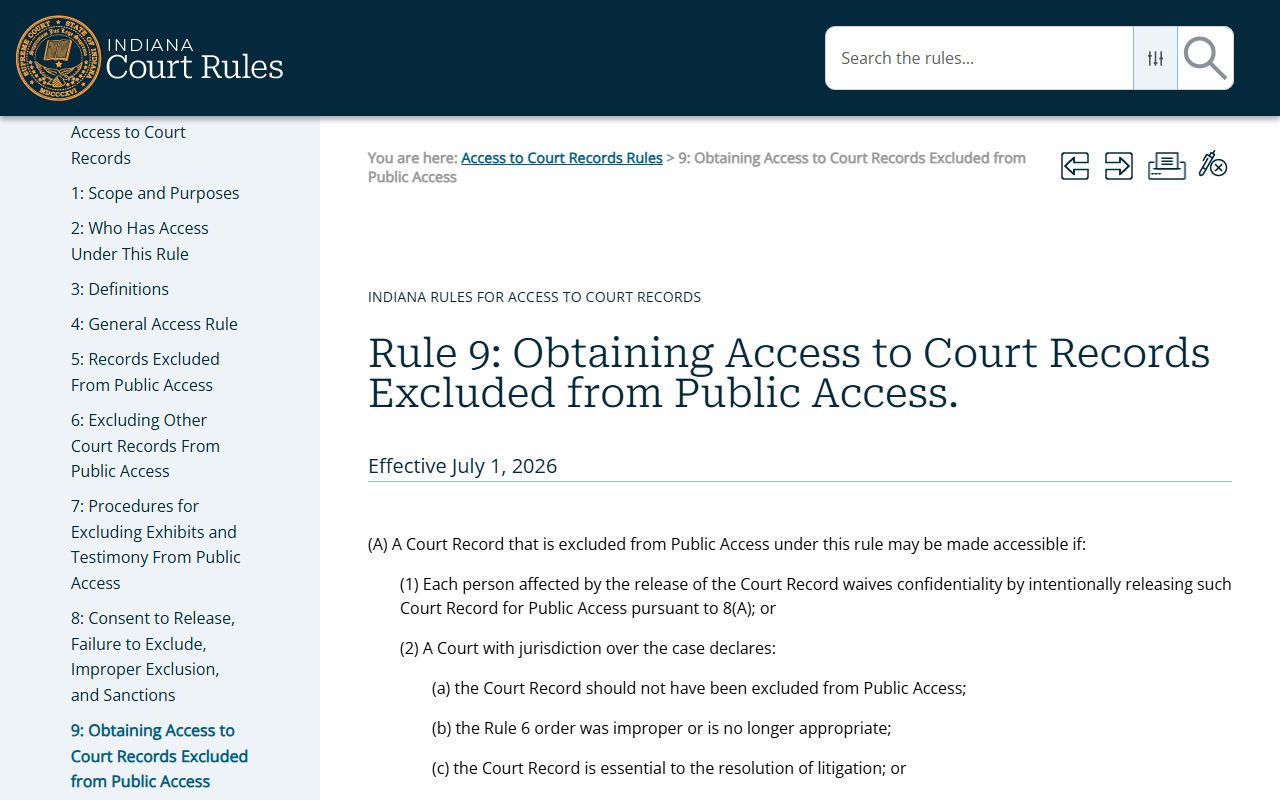
A Rule 9 request is different from a basic clerk copy request for a public charge record.
Administrative Rule 9 controls remote access to court data and bulk record access.
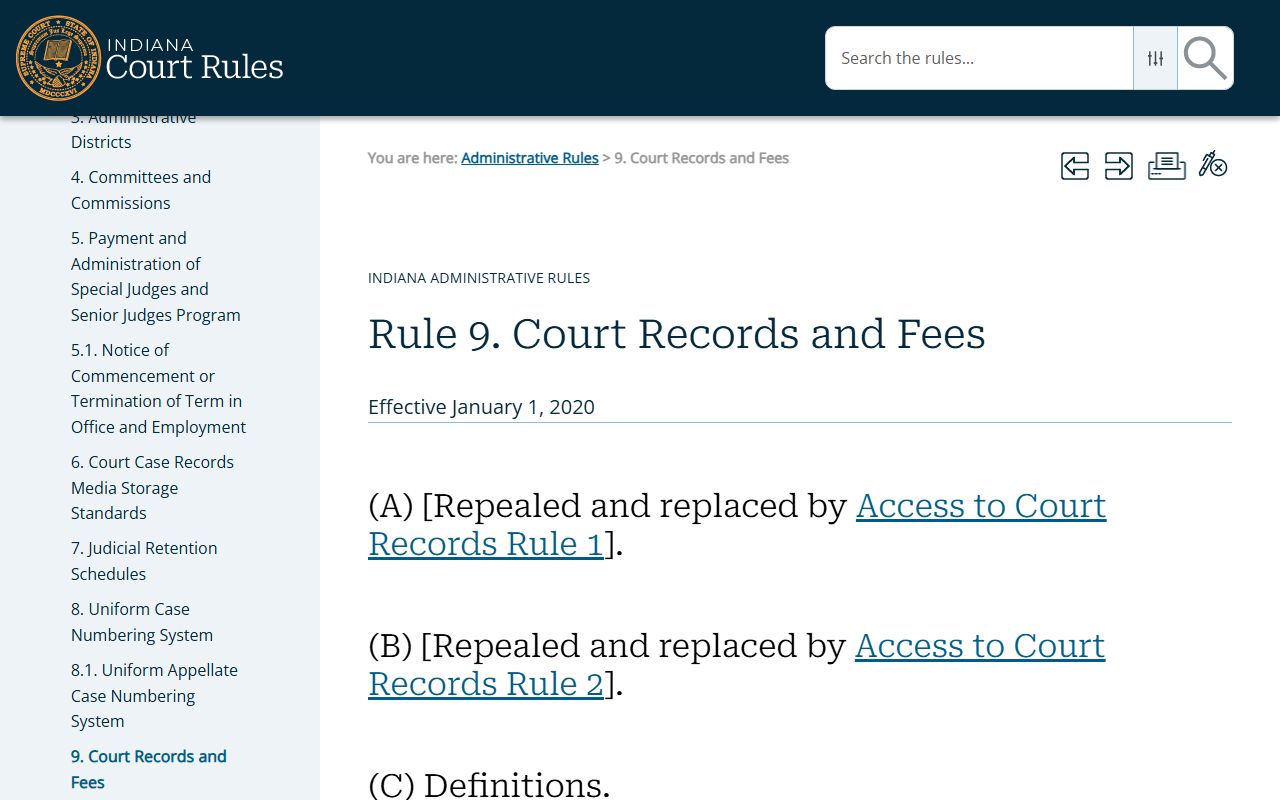
That remote-access framework shapes what charge data can be viewed online instead of at the clerk counter.
Sealed and Expunged Charge Records
Sealed and expunged records are not the same. A sealed record is withheld from public access by rule, law, or court order. An expunged criminal record is restricted through Indiana's expungement process under IC 35-38-9 after court action. Floyd County expungement petitions are assigned to the court where the highest-level conviction was entered, with local rules for cases involving the same level in multiple courts.
| Sealed | Expunged | |
|---|---|---|
| Effect | Hidden from public access while retained by court | Restricted from public access under expungement order |
| Common Source | Rule 5, statute, or judge's order | IC 35-38-9 petition and order |
| Floyd Filing Route | Handled by the assigned court | Filed through the clerk in the conviction court |
| Public Search Result | May be absent or redacted | May be removed or restricted depending on category and result |
Statewide Criminal History Context
Floyd County court charge records are court records, not a statewide background-check report. MyCase can show public Indiana case information from Odyssey courts, but official statewide criminal-history products and law-enforcement record checks are separate. Local police may provide limited local background checks, and the research notes no charge for New Albany Police limited local background checks. For court-file proof, use the Floyd County Clerk. For jail custody, use sheriff and jail channels. For sentenced state-prison custody after transfer, use Indiana Department of Correction resources.
Background-screening use has legal limits. Public charge records may be incomplete, restricted, amended, or dismissed. The presence of an arrest or charge does not prove guilt. Employers, landlords, insurers, lenders, and others with regulated screening duties need compliant consumer-reporting processes, not casual public search results.
Restricted Floyd Arrest and Charge Details
Restricted categories include juvenile cases, adoption records, mental-health records, sealed or expunged records, protected victim or witness information, full Social Security numbers, full account numbers, protected addresses, and problem-solving-court treatment or case-management materials. Sealed warrant materials and ongoing investigative details may also be withheld. Some domestic-relations, family, paternity, and protection-order records show limited public information or omit documents from online access.
Use the right office for the right record. Floyd County Clerk Danita L. Burks and the Floyd County Clerk website are the route for court charge records and certified court copies. The Floyd County Sheriff's Department handles jail, bond, crash-report, sheriff-sale, and sheriff-service records. New Albany Police handles city police reports, crash reports, records-division requests, and traffic desk questions. The prosecutor files many charges but does not serve as the clerk of the court file.