
Floyd County Trial Courts
Indiana's court system has appellate courts and trial courts. The appellate level includes the Indiana Supreme Court, Court of Appeals of Indiana, and Indiana Tax Court. The local trial level includes circuit courts, superior courts, and city or town courts where locally created. In Floyd County, record users should think in terms of one Circuit Court, three Superior Courts, and a Magistrate who hears assigned matters. Floyd County is in Judicial District 23 with Clark and Scott counties.
The Indiana Judicial Branch Floyd County local page links to MyCase, e-filing, local rules, and county court information. Public records users often start with MyCase, but court identity still matters because probate, traffic, small claims, family, criminal, and specialty matters are routed differently in Floyd County.
The manifest source for the Circuit Court is the Floyd Circuit Court page.
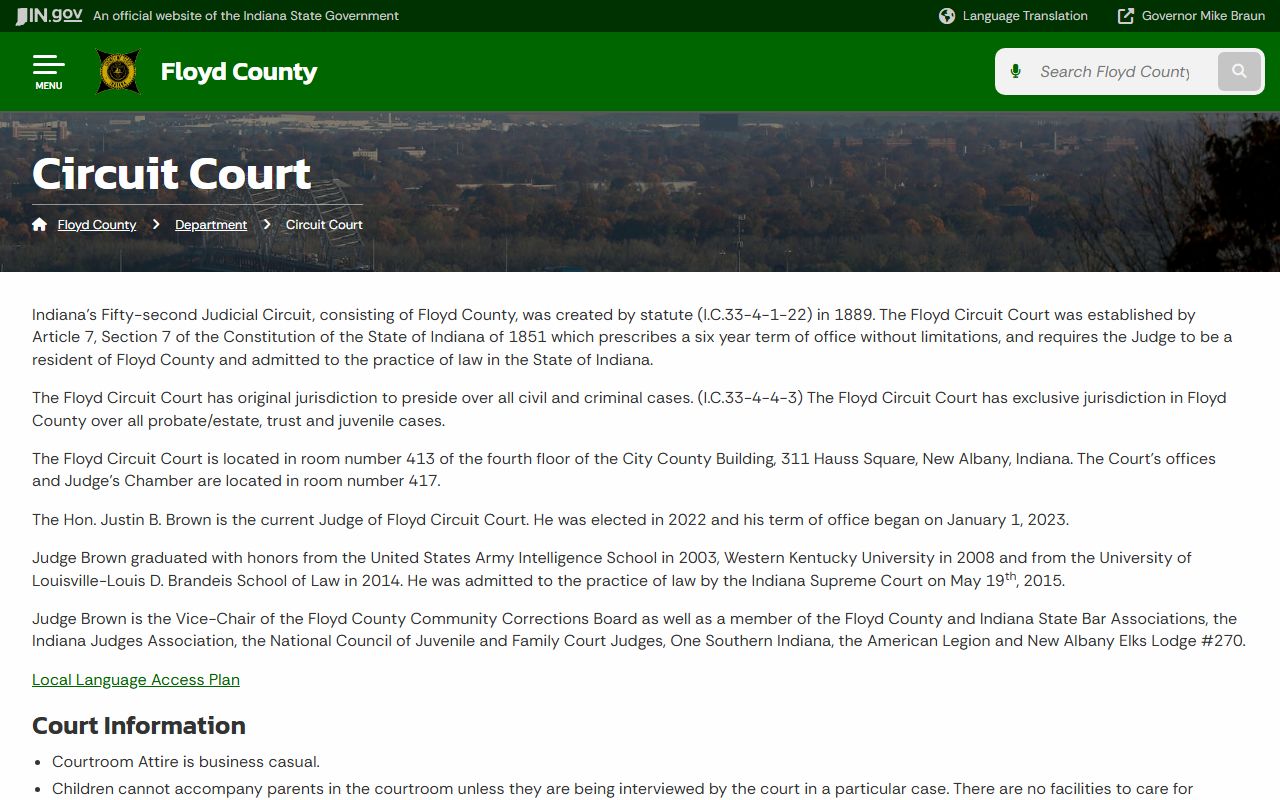
That source is central because Floyd Circuit Court holds original civil and criminal jurisdiction plus exclusive probate, trust, and juvenile jurisdiction.
Floyd County Court Contacts
The Floyd research identifies court codes, judges or officers, addresses, and phones for the main trial courts. These contacts also help distinguish the court that hears a case from the Floyd County Clerk, which accepts filings and issues copies.
| Court | Type and role | Address | Phone |
|---|---|---|---|
| Floyd Circuit Court | 22C01; civil/criminal original jurisdiction; exclusive probate, trust, juvenile; Hon. Justin B. Brown | 311 Hauss Square, Room 413/417, New Albany, IN 47150 | 812-948-5455 |
| Floyd Superior Court 1 | 22D01; general jurisdiction, felony, civil, divorce, criminal non-support; Hon. Carrie K. Stiller | 311 Hauss Square, Room 200, New Albany, IN 47150 | 812-948-5450 |
| Floyd Superior Court 2 | 22D02; former County Court, small claims, traffic, eviction, probation, alcohol/drug services; Hon. James B. Hancock | 311 Hauss Square, Room 425, New Albany, IN 47150 | 812-948-5488 |
| Floyd Superior Court 3 | 22D03; family, civil, criminal, Veterans Court, Commercial Court, problem-solving/family programs; Hon. Maria D. Granger | 311 Hauss Square, Room 421, New Albany, IN 47150 | 812-948-5257 |
| Floyd County Magistrate | Hears cases assigned from Circuit Court and Superior Courts 1, 2, and 3; Julie Fessel Flanigan | 311 Hauss Square, Room 253, New Albany, IN 47150 | 812-948-5486 |
Floyd County Case Routing
Floyd Circuit Court has exclusive probate, estate, trust, and juvenile jurisdiction. Superior Court 1 handles general jurisdiction work, including felony criminal, civil, divorce, and criminal non-support cases, but the research notes it does not hear probate, trust, juvenile, or small claims. Superior Court 2 is the practical venue for traffic, small claims, evictions, probation, alcohol/drug services, and former county-court work. Superior Court 3 handles family, civil, and criminal work and houses major specialty programs.
Small claims and evictions are filed in the Clerk's Office and are filed in Superior Court 2. Initial filings are heard by the Magistrate on the second floor, while proceedings supplemental are heard in Superior Court 2 on the fourth floor. Traffic Court is held in Superior Court 2, Room 425, each Tuesday at 4:00 p.m. except holidays. Commercial Court eligible cases are filed in Superior Court 3.
| Case or task | Local route | Record access note |
|---|---|---|
| Probate, estates, trusts, juvenile | Floyd Circuit Court | Probate may show in MyCase, but copies and many documents require the Clerk. |
| Felony, civil, divorce, criminal non-support | Often Superior Court 1, subject to local assignment rules | Search MyCase, then use Clerk for official copies. |
| Traffic, small claims, evictions | Superior Court 2, with Magistrate role for initial small claims/eviction hearings | Traffic payments and copies route through Clerk channels. |
| Veterans Court, Commercial Court, family navigation, adult problem-solving work | Superior Court 3 | Some program records may be restricted by rule or treatment-record law. |
| Assigned magistrate matters | Magistrate by assignment | The underlying case remains tied to the assigning court. |
The manifest includes the Floyd Superior Court 1 page.
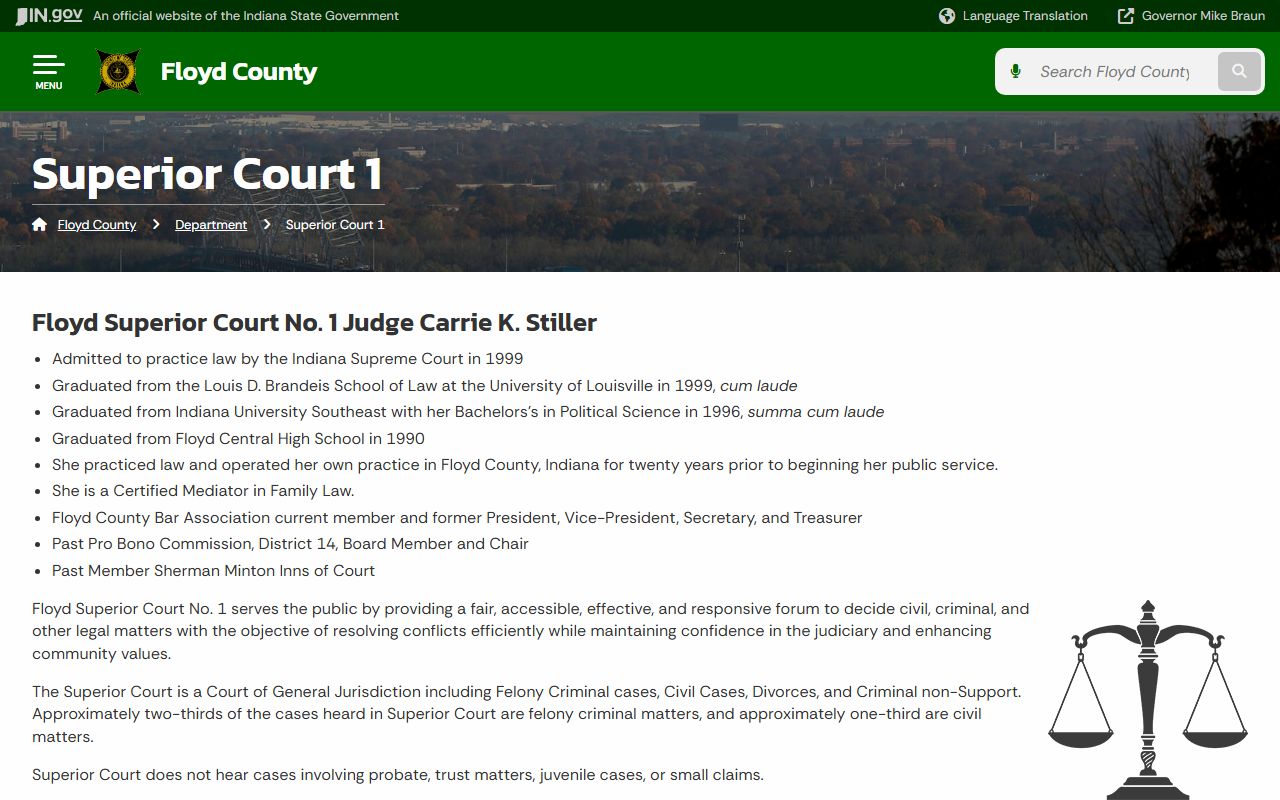
Superior Court 1 is important for Floyd County court records because it handles major civil, divorce, felony, and criminal non-support work.
Floyd County Court Comparison
Indiana does not use a Texas-style justice-of-the-peace structure for Floyd County. The local lower-court concepts in the research are city or town courts where locally created, magistrate assignments, and small claims in Superior Court 2. That means the comparison is less about dollar limits and more about where the Floyd court system routes each case type.
| Feature | Circuit Court / Superior Court | Magistrate by assignment | City / Town Court where locally created |
|---|---|---|---|
| Main role | Primary trial courts for Floyd County cases | Hears assigned cases from Circuit and Superior Courts | Local lower-court matters only where created |
| Floyd examples | Circuit, Superior 1, Superior 2, Superior 3 | Floyd County Magistrate | Not the main source for county trial-court records in the research |
| Records path | MyCase and Floyd County Clerk | Underlying assigning court plus Clerk | Local court route if a city/town court record exists |
| Common case types | Civil, criminal, family, probate, traffic, small claims, specialty courts | Assigned hearings and initial small claims/eviction matters | Varies by local court authority |
Floyd County Case Movement
A case usually starts with a filing, citation, arrest, petition, or complaint. The Clerk accepts filings and payments. The court handles hearings, orders, judgments, and case management. MyCase then displays public case data when the case is eligible for public access and the information is in Odyssey or converted from earlier systems.
Civil and family flow: Filing › service › answer or response › hearings or mediation › order or judgment › post-judgment activity › appeal if filed.
Criminal and traffic flow: Arrest or citation › prosecutor or court filing › initial hearing or traffic appearance › pretrial events › plea, deferral, dismissal, or trial › sentence, fine, or license action › appeal if filed.
The manifest includes the Floyd Superior Court 2 page.
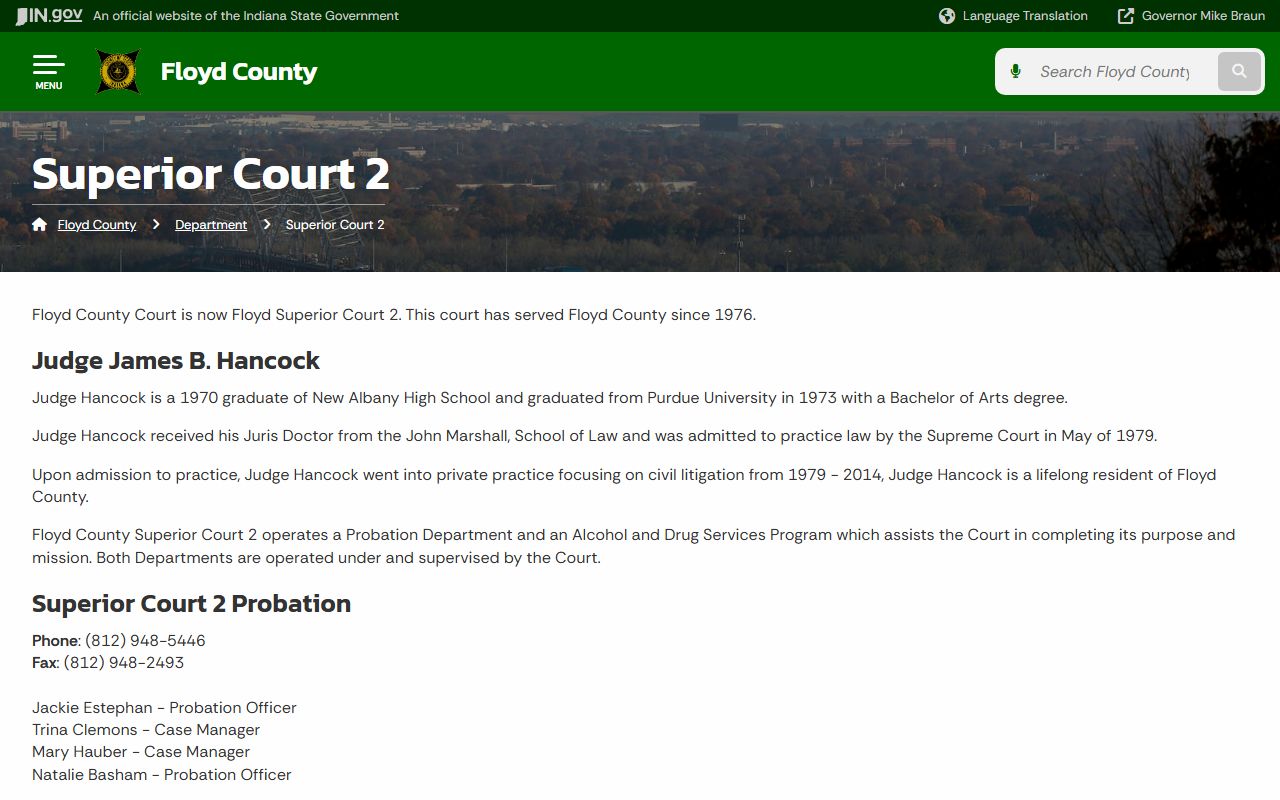
Superior Court 2 is especially relevant for traffic records, small claims, evictions, probation, and alcohol/drug services.
Floyd County Specialty Courts
Floyd Superior Court 3 houses several programs that affect case routing and record expectations. Veterans Court of Southern Indiana is linked from Superior Court 3 and has operated since 2011 for people who served in the armed forces and face a criminal charge. The program emphasizes recovery, peer support, housing, education or work, accountability, and a justice, military, and behavioral health team. Local rules route many criminal and traffic cases involving military history to Superior Court 3.
Floyd County Problem-Solving Court programs operate under Indiana law and local rules, with day-to-day management assigned to Superior Court 3. Services can include assessment, education, treatment referral, coordination, and case management. Commercial Court eligible cases are filed in Superior Court 3 because Judge Maria D. Granger is one of Indiana's Commercial Court judges. Family navigation and ADR initiatives also sit with Superior Court 3, and the divorce packet names a Family Law Navigator for self-represented litigants.
The manifest includes the Floyd Superior Court 3 page.
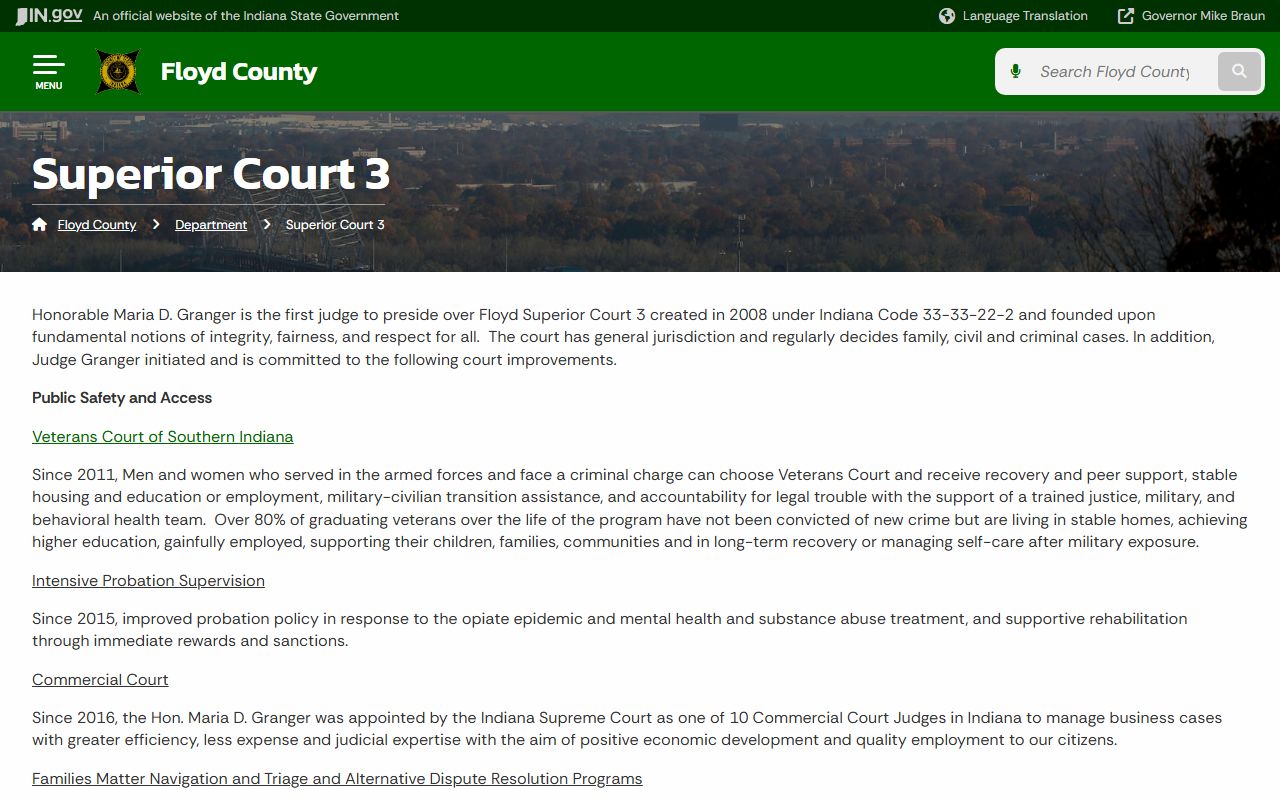
Superior Court 3 is the key Floyd County source for Veterans Court, Commercial Court, problem-solving work, and family navigation records.
Floyd County Magistrate Records
The Floyd County Magistrate hears cases on assignment from the Circuit Court and Superior Courts 1, 2, and 3. The Magistrate is listed at 311 Hauss Square, Room 253, New Albany, IN 47150, phone 812-948-5486. For records, the key point is that a magistrate hearing does not create a separate record system. The docket and documents remain tied to the underlying court and cause number.
Small claims and eviction initial filings are examples where the Magistrate may be the hearing officer while the case remains routed through Superior Court 2. Divorce timing also appears in Magistrate and court FAQ material, including the 60-day minimum waiting period after filing. Record users should search by the case number or party in MyCase and contact the Clerk if the hearing officer or courtroom is unclear.
The manifest source for this court officer is the Floyd County Magistrate page.
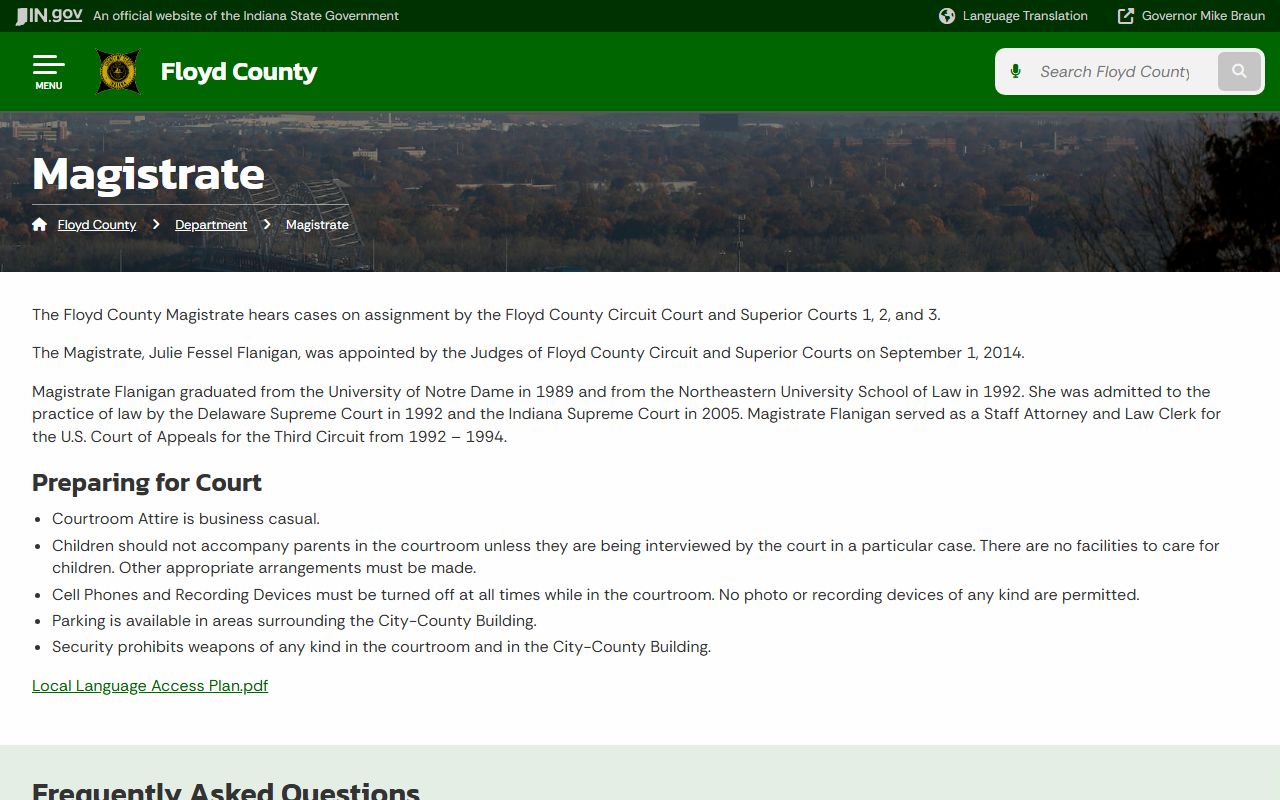
The Magistrate page supports the local routing point: assigned hearings may be heard by the Magistrate while records stay with the assigning court.
Floyd County Appeals Distinction
Appeals from Floyd Circuit and Superior Court cases generally go to the Court of Appeals of Indiana unless the case falls within direct Indiana Supreme Court or Tax Court jurisdiction. The Clerk of the Supreme Court, Court of Appeals, and Tax Court is separate from the Floyd County Clerk. State appeals are not filed in the U.S. Court of Appeals unless the case is federal.
Federal court is separate from Indiana MyCase. Floyd County is in the New Albany division of the U.S. District Court for the Southern District of Indiana. The federal courthouse is the Lee H. Hamilton Federal Building and U.S. Courthouse at 121 West Spring Street. Federal records use PACER or CM/ECF. Bankruptcy matters use the U.S. Bankruptcy Court for the Southern District of Indiana, New Albany division. Federal appeals from the Southern District go to the Seventh Circuit, not the Indiana Court of Appeals.
Note: If a case is federal, bankruptcy, or immigration, MyCase and the Floyd County Clerk are not the right record systems.